Friday, 3 February 2023

Persona (1966)

Persona is a Swedish film directed by Ingmar Bergman, who lots of people regard as one of the greatest filmmakers of all time. Persona reflects the time it was made and fits perfectly with the experimental, new-wave cinema movement, that was occurring around the world.

I feel most films, most creative acts in general, fall short of something. Most creative acts aren’t challenging. They don’t make you think about the relationship between form and content. They don’t make you think about what it means to be human. They don’t make you think about what it means to create meaning and express transcendent insights. Persona, however, makes you think about all these things.

Another thing that I feel makes art powerful is when it can’t be pinned down or explained away. It’s that suggestibility of certain works of art, that mystery, which seems to most accurately mirror reality itself.

I find it interesting that Persona was released during the same year as two other films which share very similar plot themes. They are all also experimental and challenging. One of those films is The Face of Another (1966) by Hiroshi Teshigahara and the other is Seconds (1966) by John Frankenheimer. I won’t go into detail with these other films, but like Persona they all focus heavily on the nature of identity. They all explore the masks, or personas, that people adopt in daily life. Ultimately, they all suggest that these masks don’t express the truth of what’s behind them.

Persona is self-aware. The experimental prologue shows extreme close-up shots of a film reel, as though we’re inside the film-viewing process. We also see a young boy touching a screen/wall, with a woman’s blurred face on it. This signifies the idea of spectatorship. We’re immediately being invited to think about what it means to make and watch films. We’re being reminded that we’re spectators in the process of watching a work of art. We’re not being asked to suspend disbelief. In the prologue we also see rapid flashes of scenes from silent movies, again asking us to reflect on the art of cinema, the vehicle of expression that we’re currently experiencing. These flashes open the film up, like James Joyce does with literary references in Ulysses and Finnegans Wake, showing us how the film is connected to, and owes a debt to, previous films.

The discordant, experimental score in the prologue, by Lars Johan Werle, is fitting, further showing us that we’re inhabiting a different level of reality at this point. The inharmonious score suggests that we’re experiencing a world that bypasses our rational, Newtonian one, suggesting a deeper, more pure form of reality, one where opposites visibly co-exist and apparent discord reigns.

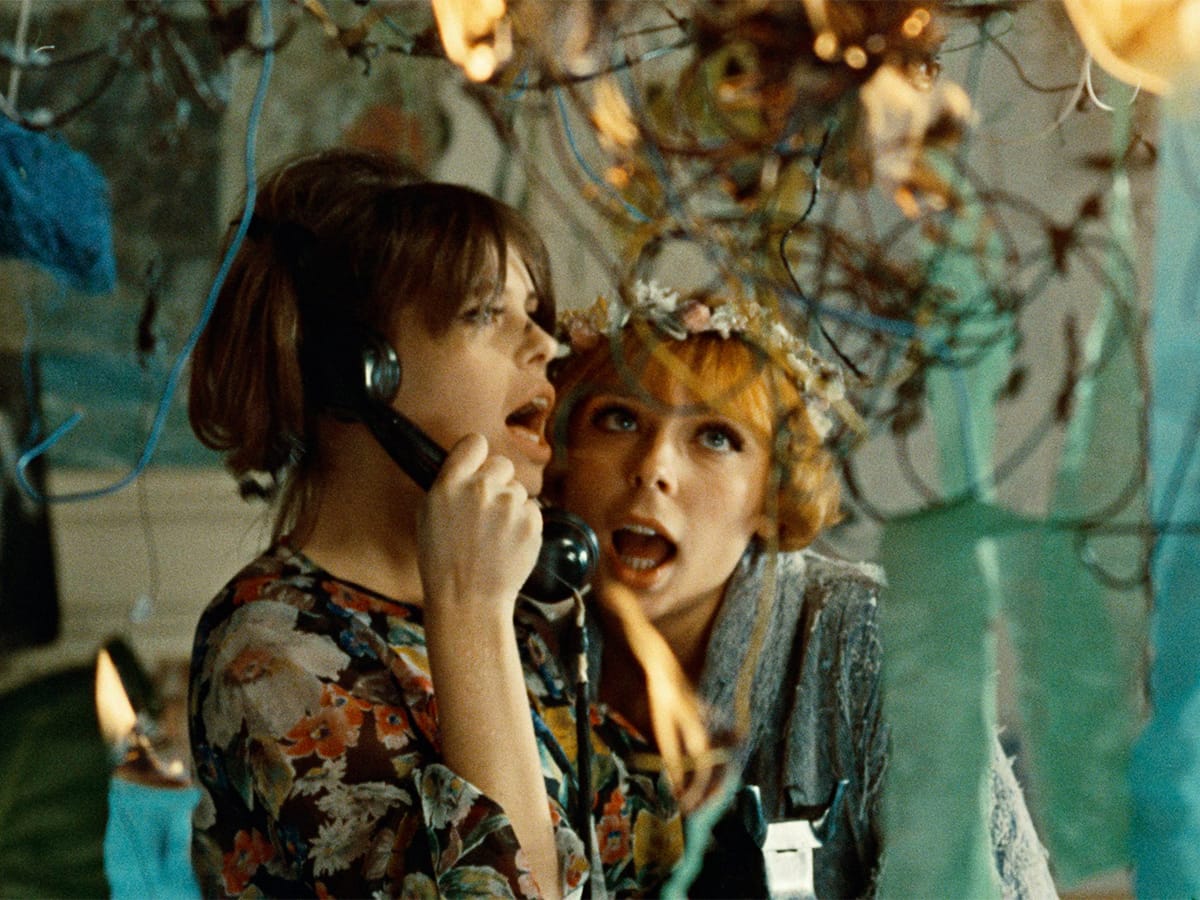
Daisies (1966)

Daisies is a particularly unique czech new-wave film and is wonderful for its experimentation, humour and visual madness. As with most great films, you can't really pin down the meaning of this one. It features two young women who make a decision that if the world is spoiled, then they will be spoiled. They thus embark on an unhinged, madcap odyssey in which they dine and tease older men, cause havoc in a nightclub, get into food fights, and cut each other up with scissors in one of my favourite, bonkers scenes.

What I love about this film is the sense of liberation and freedom it gives. The film is an uninhbited, humorous exploration of cinematic form which never ceases to entertain. It reminds me, to some extent, of the Japanese film Hausu (1977), in that Hausu is equally uninhibited and formally experimental. 

If one wanted to get all political, one could read Daisies, through the unfettered adventures of its female characters, as an anarchist and feminist film. I say this as you have two women defying social conventions, toying with men and freely expressing themselves (albeit in an absurd, silly way). 

Daisies was made a female director, Věra Chytilová. I feel this is worth pointing out as there weren't a huge amount of female directors at the time, especially making films like this. Ultimately, Daisies perfectly encapsulates the experimental, subversive mood of 60s new-wave cinema.

Saturday, 5 November 2022

A Fragment

Placidly sat on a chair in my kitchen, alone but not lonely, I look out of the French doors 

This whole morning speaks of quietude and calm neutrality 

French doors ajar, I hear an intermittent, soft rustling amidst the trees outside, as a breeze caresses the multitude of autumnal leaves 

My faulty tap slowly drips in the metal sink 

Contentedly I partake of my morning coffee ritual, hot liquid comforting my insides on this chilly October morning 

I gaze at my floorboards and admire the grain in the wood, patterns of nature frozen in time 

My mind tries to find some deeper meaning to all this, some philosophical substrate 

But maybe some moments don't require a deeper meaning, maybe this calm, ordinary morning is perfectly sufficient, sufficiently perfect 

This morning is complete and beautiful as it is, with the rustling of the leaves, the dripping of the tap, and the patterns in the wood 

A Fragment

In the sky an expanse of pleated gowns glowed pink, as the sun dipped below the horizon of my world 


Softly radiant, pastel pink, these chalky gowns were spread delicately yet majestically across a pale blue canvas 


Supremely elegant and graceful was the rendering of their existence, as though nature herself were the greatest artist and was showing off 


The pink hue of this dusky, chalky, pastel evening cast itself upon my surroundings, as my world bathed in its delight 


The city streets, the buildings, the pedestrians fluttering by, all were clothed in pink 

Friday, 4 November 2022

A Fragment

I stare at my face in the bathroom mirror and look into my weary eyes 
What have I become?
I no longer know how to live
I no longer understand what matters
Bereft of meaning, I am adrift in a cold, godless city 
 
Wandering the litter-strewn streets, hurried groups of workers rush past me
Faces buried in smartphones, dim light falling on vacant expressions 
E-scooters swerve by arrogantly in the sleepless, neon night 
Teenagers stand on pavements, pouting and taking pictures of each other "yaaass queen this one's goin’ on insta” 
A drunk man stumbles around, bellowing incoherently 
 
I do not share my feelings, my thoughts
I fasten my heart with silence and isolation
I am suffocated by my obstinacy and independence 
In a city constantly buzzing with noise and people and lights, I have never felt so alone 
Hopeless, desperate, I drink more whisky to assuage the pain 
 
Where are my childhood days, care-free and blissful? 
Where is my mother, who once held me in her arms? 
Where are the times when we reaped the bounties of our own seeds and tilled our own soil? 
Where are the gods and myths of old? 
Where are the moments of bravery, loyalty and self-sacrifice? 
 
I cast my thoughts to the past 
Though we have more convenience nowadays, something vital has been lost 
No longer do I see brave, chivalrous figures 
No longer do I see humbleness, authenticity, respect and connection 
Yet ultimately, I only blame myself for the way I feel 
 
I am the one who is wrong, tainted, depraved 
My existence is a mistake, an aberration 
I cannot be mended, repaired, put back together 
I am Humpty Dumpty 
Loneliness and suffering are my lot 
 
Again, I wandered the grimy streets 
Tripping over a curb, inebriated, I fell upon the unforgiving floor 
Lying on the street, lame and helpless, a soft, warm voice emerged from the night “are you okay, my friend?” 
Her blue eyes smiled at me and she extended her hand to mine 
Looking into my blood-shot eyes, she spoke again “you’re not alone” 

Saturday, 30 April 2022

A Fragment

My cramped, little garden was a mess 

A funny smell lingered by the drain 

I sat alone, was I the only one to greet the morning sun? 

Wisps of cloud were scattered across a pale blue canvas 

Pleasant birdsong emerged from the silent, peaceful emptiness 

Nothing is more fertile than emptiness 

The bird continued chirping its pleasant song 

Other birds joined in, and the song became a beautiful chorus 

The birdsong was unintelligible to me, yet it meant everything to me 

The chorus continued a little longer, as the birds sang sweetly to each other 

The sounds emanated from the silent emptiness, then dissipated, only to begin again 

Somehow, in my cluttered garden, the eternal dance of creation and destruction, life and death, transformation and renewal, played out before me 

Was I the only one to meet this quiet, peaceful morning? 

Ahh, the warm sun felt nice upon my skin 

I'm grateful to be alive

Thursday, 17 March 2022

Program Me

The society and culture in which we grow programs us to think in a specific fashion. Our view of reality is thus coloured by our socio-cultural environment. But many people are unaware that their minds have been programmed. Many people feel that their constructed reality is true and don’t think that another way of looking at things might exist. To understand the fact that there are multiple ways of looking at the world, some of which are radically different from others, is very beneficial.

Cultural and societal institutions want you to fall in line. They want to control you, so that you don’t wake up and think for yourself. Even institutions which deem themselves to be moral often just want to exert control over people, whether they are conscious of this or not. This is why I'm usually distrustful of overt moralising and sanctimonious behaviour.

Many live in what some might call “the matrix”. The matrix, to me, means a distorted copy of reality, built up over time by a specific culture. It can be wielded or encouraged by people in powerful positions to stop others from waking up and taking control over their lives.  


Socio-cultural conditioning stands between us and a more naked, independent, true understanding of how things work. Many people, it seems, go from birth to grave without perceiving things for what they are. Other people feel they perceive things clearly, because they have educated themselves about politics, for example, or have adopted “alternative” views about the world, but are just as much in the matrix as most others. Other people, again, may have educational qualifications and can learn to repeat knowledge in a robotic way, but still lack a fundamental awareness of how things work. This is why I don’t value things in the same way other people do. I don’t necessarily think it’s amazing that someone has got a first-class degree from the University of Oxford, for example. I would be more impressed if someone has created a beautiful work of art, regardless of whether this work of art was unpopular or not. 


It is difficult to determine what fundamental awareness means or whether some people have woken up or not. Waking up can’t be explained in the same way we explain what a chemical process is, but it involves a dissolution of socio-cultural conditioning and a consequently clear perception of how reality works. Ground-breaking artists often achieve this kind of awareness. Artists challenge the dictates of the culture around them when they create something fresh and innovative. They have cast their minds into the unknown and brought insights back into the known. They have made things conscious that were previously unconscious. 


Reality has a lot to teach us. We need to be receptive. We need to listen, observe and contemplate. We need to humble ourselves to the chaos and majesty of the unknown and integrate its teachings into our lives. We also need to realise that understanding is a continual process. No matter how aware you are, you always have something new to learn. 

Western Values

  A certain narrative ha s become more prominent in recent times , with various well-known proponents . T his narrative tell s us that ...